




 1064 / 5157

Nexon Gasoline – EMS ECU Bosch
DTC Troubleshooting Manual
Version: 0.1
Date: 26-08-2017
Prepared By: Sunu S Babu/Yogesh Jadhav
Checked By: Yeshwant Jadhav
Approved By: Satish Kumar
Document Part No: 2921 02 224 A1736
Page: 1060 of 1203
Copyright ©
TATA MOTORS Ltd.
This document must not be used in any way, such as copying and redistributing to third parties, without the consent of author.
P2271-37: Downstream Oxygen Sensor Signal Stuck Rich – Signal Frequency Too High
Overview:
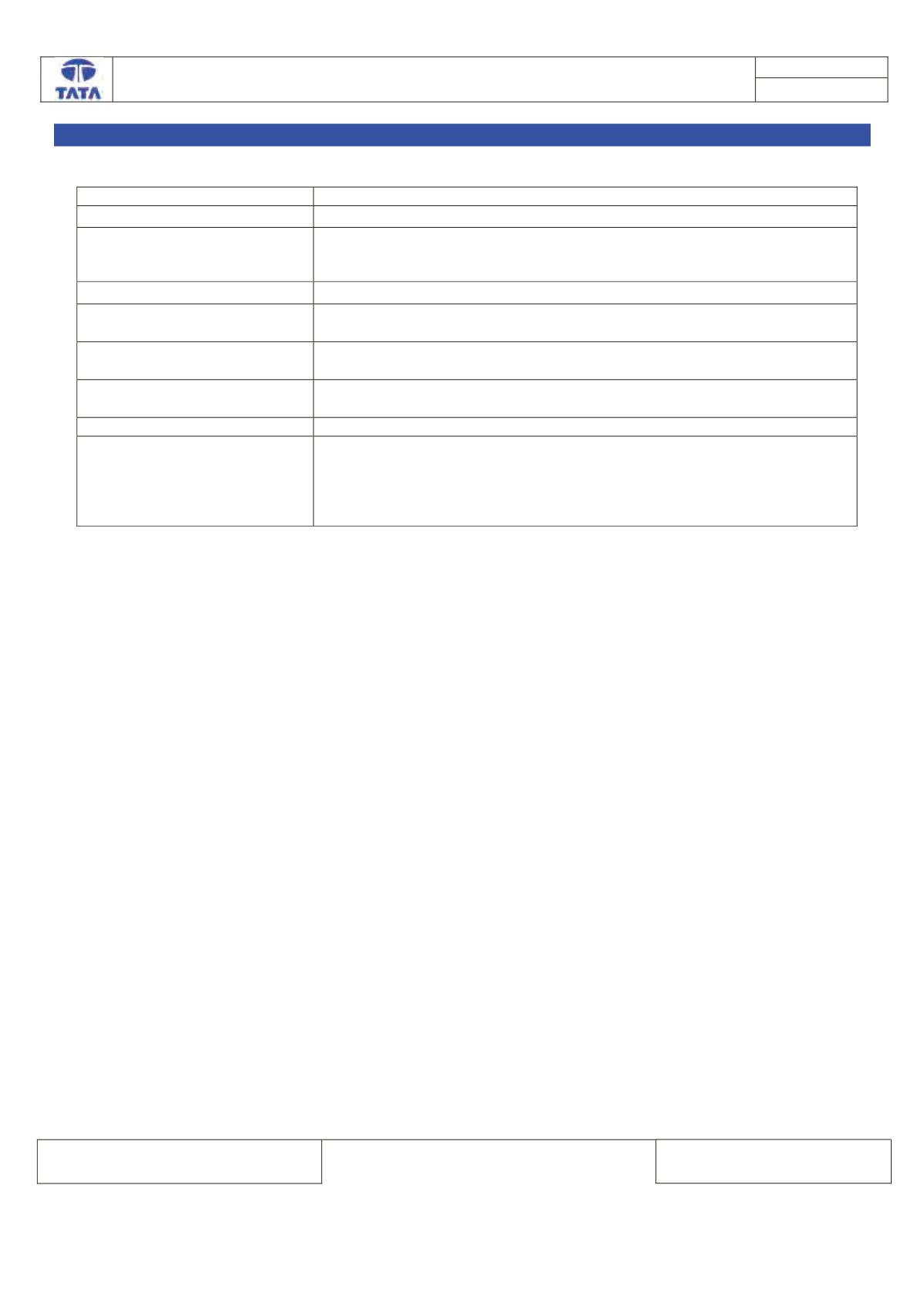
ISO Code
P2271 – 37
Customer Symptom
Drivability will get affected during idle and part Load conditions
Fault Effects (On Vehicle)
1. Deactivation of Lambda regulation behind Catalyst.
2. Emission will detoriate.
3. Sluggish response for transients and Bad drivability.
Lamp Status (If Any)
MIL ON after 3 drive cycles
Fault Detection Condition
This fault gets logged if EMS ECU finds the downstream oxygen Sensor
signal’s rate of change is above threshold.
Normal Operating Condition
Downstream oxygen Sensor signal is plausible wrt Engine operating
condition.
Probable Trouble Area
Wiring Harness Connections / Sensor
Healing Condition
Engine running and 3 drive cycles
Fault permanent deletion
1. Clear DTC Command form Scan tool
2. Stack Over Flow.
3. 40 warm up cycles.
4. ECU Flashing.
5. ECU Power-Fail
Component Details:
Lambda Sensor:
The oxygen Sensor operates on the principle of galvanic oxygen concentration cell (Nernst cell) with
solid electrolyte (Nernst's principle). The ceramic sensing element is a conductor of oxygen ions from a temperature of
350 C. A heater is integrated on the sensing element. It is placed into the exhaust manifold. The sensing element
compares the residual oxygen content in the exhaust gas with the oxygen content in the reference atmosphere (air
surrounding the sensing element). This gives an output voltage between 100mV (lean exhaust gas) to 800mV (rich
exhaust gas), depending on whether the exhaust gas is lean or rich.
Preliminary Checks:
1) Loose/ Damaged Connections between Sensor and EMS ECU.
2) Check for back out of pins at both Sensor connector and ECU connector.
3) Check for damage of pins at both Sensor connector and ECU connector.
4) Check the continuity from Sensor connector pins to the ECU pins.