




 505 / 5157

Nexon Gasoline – EMS ECU Bosch
DTC Troubleshooting Manual
Version: 0.1
Date: 26-08-2017
Prepared By: Sunu S Babu/Yogesh Jadhav
Checked By: Yeshwant Jadhav
Approved By: Satish Kumar
Document Part No: 2921 02 224 A1736
Page: 501 of 1203
Copyright ©
TATA MOTORS Ltd.
This document must not be used in any way, such as copying and redistributing to third parties, without the consent of author.
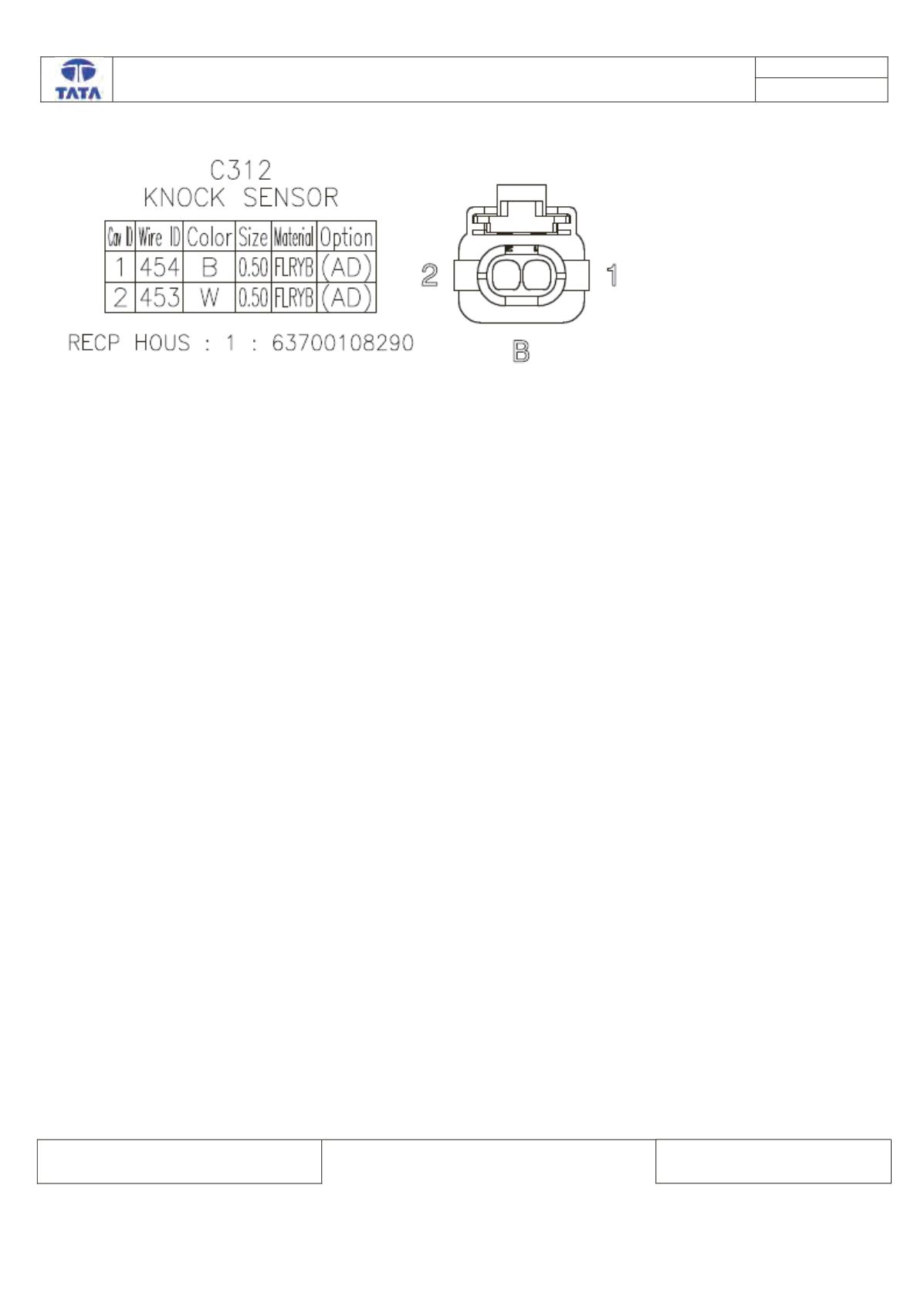
Connector View & Information: -
Sensor Specification and Sensor standalone diagnosis:-
The knock Sensor provides input to ECU based on the vibration generated by 'knocking', which will enable ECU to
limit
ignition timing (Advance) for optimum efficiency. The knocking is the vibration generated due to uncontrolled
combustion,
due to which a charge transfer occurs in the Sensor and as a result voltage is generated which is transmitted to ECU.
The knock Sensor is mounted on the cylinder block.
Application of Knock Sensors
:- A piezo sensitive knock Sensor with linear characteristic
is mounted on the engine block. It transforms the structure borne vibrations into electrical signals which
can be evaluated by the engine’s ECU. The knock Sensor signal is evaluated according to intensity and
spectral information of knocking and non-knocking combustions. As a consequence the ignition parameter
will be adjusted for the next combustions.
Temperature range:- -40 degree C to +180 degree C
Mechanical &Electrical characteristics:-
Main resonance frequency of Sensor head: > 30 kHz
Up to 30kHz the sensitivity must not exceed 200 mV/g.
Capacitance (of Sensor head): C = 1150 ± 200 pF
Capacitance measured at frequency 1 kHz, parallel;
Sensor mounted with torque 20 ± 5 Nm
Due to parallel Circuit of both Sensor head and wirecapacitance only the total capacitance can bemeasured.
Temperature dependence of capacitance, related to20°C room temperature
for temperatures - 40 °C ... + 20 °C ≤ 1,9 pF/K
for temperatures +20 °C ... + 150 °C ≤ 3,3 pF/K
Shunt resistor: 4,9 MΩ ± 20%
after ageing: 4 – 10 MΩ(
resistance between 2 signal leads)
Resistor
Pin for supporting sleeve > 1 MΩ
Temperature-dependence of sensitivity at 9 kHz:
≤ -0,04 mV/(g*K)