




 1275 / 5157

OSPREY- Application
DTC Troubleshooting Data
Version: 4.0
Date: 10-02-2017
Prepared by: Mithipati Prasad
Checked by: G S Raju / Senthilnathan S
Page: 64 of 654
Copyright ©
TATA MOTORS Ltd.
This document must not be used in any way, such as copying and redistributing to third parties, without the consent of author.
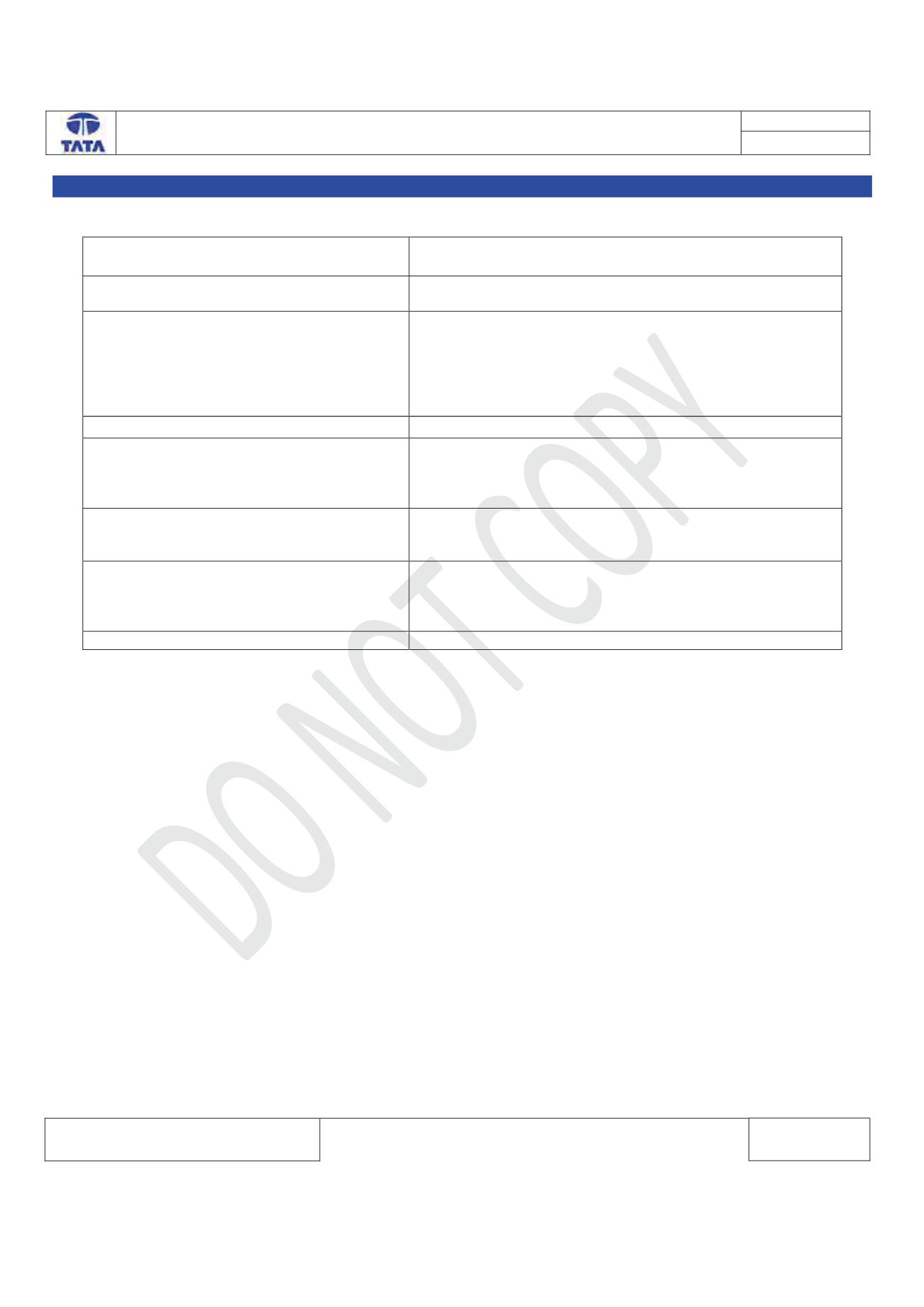
P0236: Turbocharger/Supercharger Boost Sensor A Circuit range or Performance
Overview:
DTC Description as per ISO standard
Turbocharger/Supercharger Boost Sensor A Circuit
range or Performance
Customer Symptom
Engine restricted performance
Probable Black Smoke
Fault Effects (On Vehicle)
Reduced torque mode will be activated
Speed Pilot control (Dynamic Injector learning) gets disabled
VGT actuator control will be disabled.
Disables EGR by setting desired rate to 0. This will affect
EGRH rate, EGRL rate, IFLAP, Throttle, Intake manifold
pressure and boost pressure.
Lamp Status (If Any)
CE lamp ON
Fault Detection Condition
This fault gets logged if EMS detects a lack of coherence
between the boost pressure and Atmospheric pressure or
lack of coherence between boost pressure and intake air
pressure.
Normal Operating Condition
Boost pressure is found plausible (Boost pressure coherence
exists with Intake air pressure and atmospheric pressure) with
respect to the Engine operating condition.
Probable Trouble Area
Wiring Harness Connections (Sensor signal pin shorted to
GND), Inlet Air Circuit Clogging, Sensor faulty, Turbo charger
faulty, VGT Actuator / EGR valve faulty, Intercooler pipes
damage leading to charge air leakage.
Healing Condition
1 Driving cycle after fault rectification
Component Details:
Boost pressure sensor consists of a silicon chip mounted inside a reference chamber. On one side of the chip is the
reference chamber and on the other side is the pressure to be measured. The electrical resistance of the chip varies with
the variation of pressure. This change in resistance alters the voltage signal. ECM interprets the voltage signal as
pressure and any change in voltage signal a change in pressure.
Preliminary Checks:
x
Check whether the customer voice / view about the issue is matching with the fault effects mentioned above. If
yes, go ahead with next steps. If not, check for other DTC’s presence.
x
Check whether similar complaints are earlier reported. If yes, perform the preliminary checks with respect to earlier
issue closure.
x
Inlet Air Circuit Clogging?
x
VGT Actuator faulty?
x
Turbo charger Faulty?
x
Loose/ Damaged Connections between Boost Pressure Sensor and EMS ECU.
x
Check for back out of pins at both Boost Pressure Sensor connector and ECU connector.