




 1622 / 5157

OSPREY- Application
DTC Troubleshooting Data
Version: 4.0
Date: 10-02-2017
Prepared by: Mithipati Prasad
Checked by: G S Raju / Senthilnathan S
Page: 411 of 654
Copyright ©
TATA MOTORS Ltd.
This document must not be used in any way, such as copying and redistributing to third parties, without the consent of author.
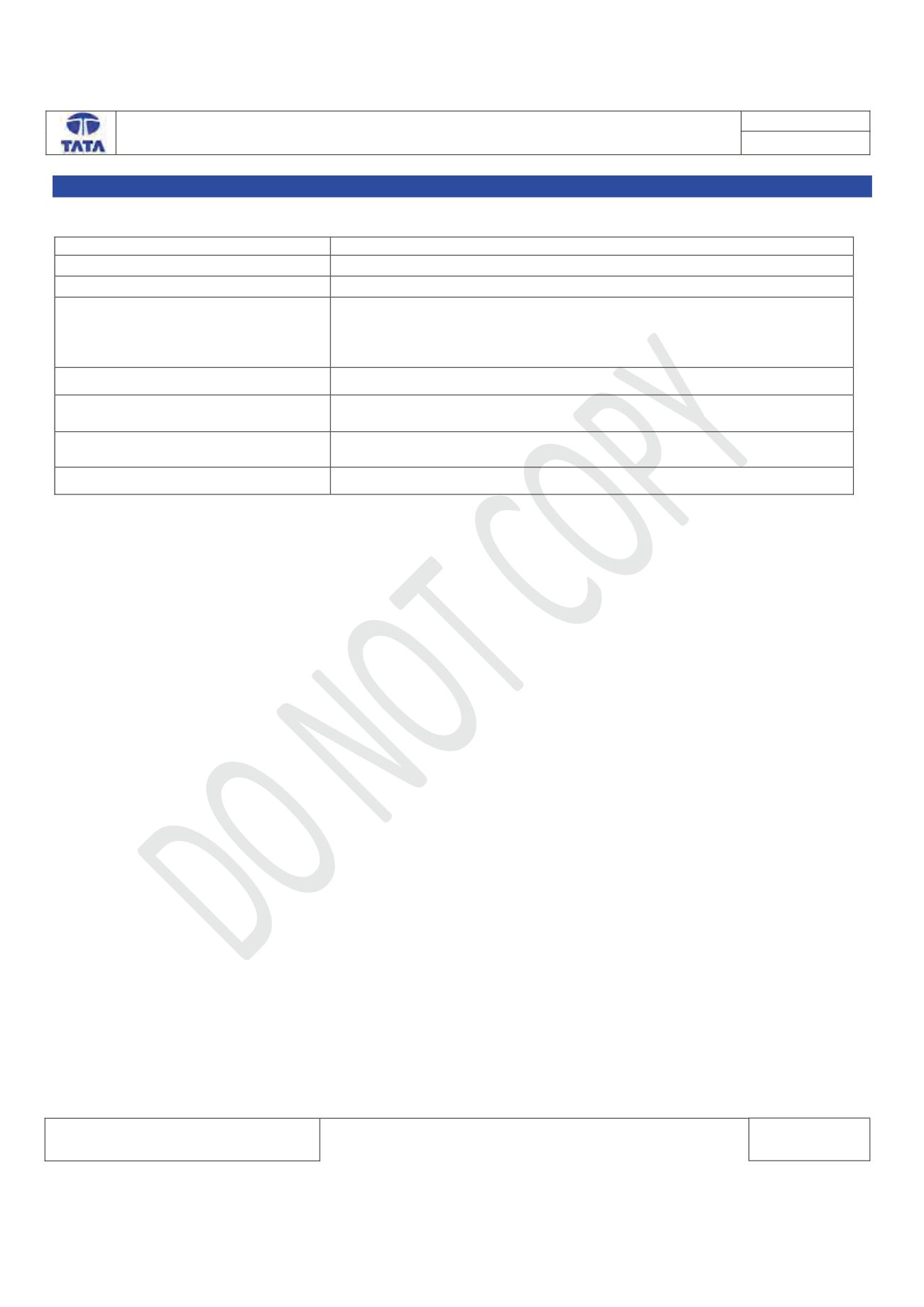
P1287: Electrical Resistance in the Injector Circuit Is Too High
Overview:
DTC Description as per ISO standard
Injector wiring resistance too high.
ECU Pin Number
6,7,25,44,63
Customer Symptom
Engine may have abnormal noise and vibrations.
Fault Effects (On Vehicle)
Disables rail pressure control trim fault detection
Disables all injectors pulse width correction based on current
measurement, this correction is based on battery voltage and coolant
temperature
Lamp Status (If Any)
CE lamp is on
Fault Detection Condition
This DTC gets logged, if wiring harness resistance of any Injector goes
above the upper threshold.
Normal Operating Condition
Resistance of the Injector 1/2/3/4 pairs wiring harness resistance shall be
less than 150 milli ohms each and greater than 50 milli ohms each..
Probable Trouble Area
Injector Bank, ECU, Grounding points, Injectors Wiring harness resistance.
Component Details:
The function of the fuel injection system is to provide the right amount of fuel at the right moment and in a suitable
condition for the combustion process. There must therefore be some form of measured fuel supply, a means of timing the
delivery and the atomization of the fuel.
Injector has two basic parts, the nozzle and the nozzle holder or body. When EMS energizes the injector solenoid, the
high-pressure fuel enters and travels down a passage in the body and then into a passage in the nozzle, ending finally in
a chamber surrounding the needle valve.
The needle valve will open when the fuel pressure acting on the needle valve tapered face exerts a sufficient force to
overcome the spring compression. The fuel then flows into a lower chamber and is forced out through a series of tiny
holes. The small holes are sized and arranged to atomize, or break into tiny drops, all of the fuel oil, which will then readily
burn. Once the EMS turns off the injection pulse, needle valve will shut quickly under the spring compression force.
Preliminary Checks
x
Check whether the customer voice / view about the issue is matching with the fault effects mentioned above. If
yes, go ahead with next steps. If not, check for other DTC’s presence.
x
Check whether similar complaints are earlier reported. If yes, perform the preliminary checks with respect to
earlier issue closure.
x
Check injector connector; Key off ignition and wait for 10 seconds. Disconnect the injector clean and reconnect
properly. Check if problem vanishes.
x
Check the resistance of Injector pairs wiring harness. If any injector pair resistance is less than 50 milli ohms, then
replace the injector wiring harness.
x
Check for P1201, P1202, P1203, P1204 DTC’s. If found rectify them by following their rectification procedure.
x
Loose/ Damaged Connections between injector and EMS ecu.