




 1548 / 5157

OSPREY- Application
DTC Troubleshooting Data
Version: 4.0
Date: 10-02-2017
Prepared by: Mithipati Prasad
Checked by: G S Raju / Senthilnathan S
Page: 337 of 654
Copyright ©
TATA MOTORS Ltd.
This document must not be used in any way, such as copying and redistributing to third parties, without the consent of author.
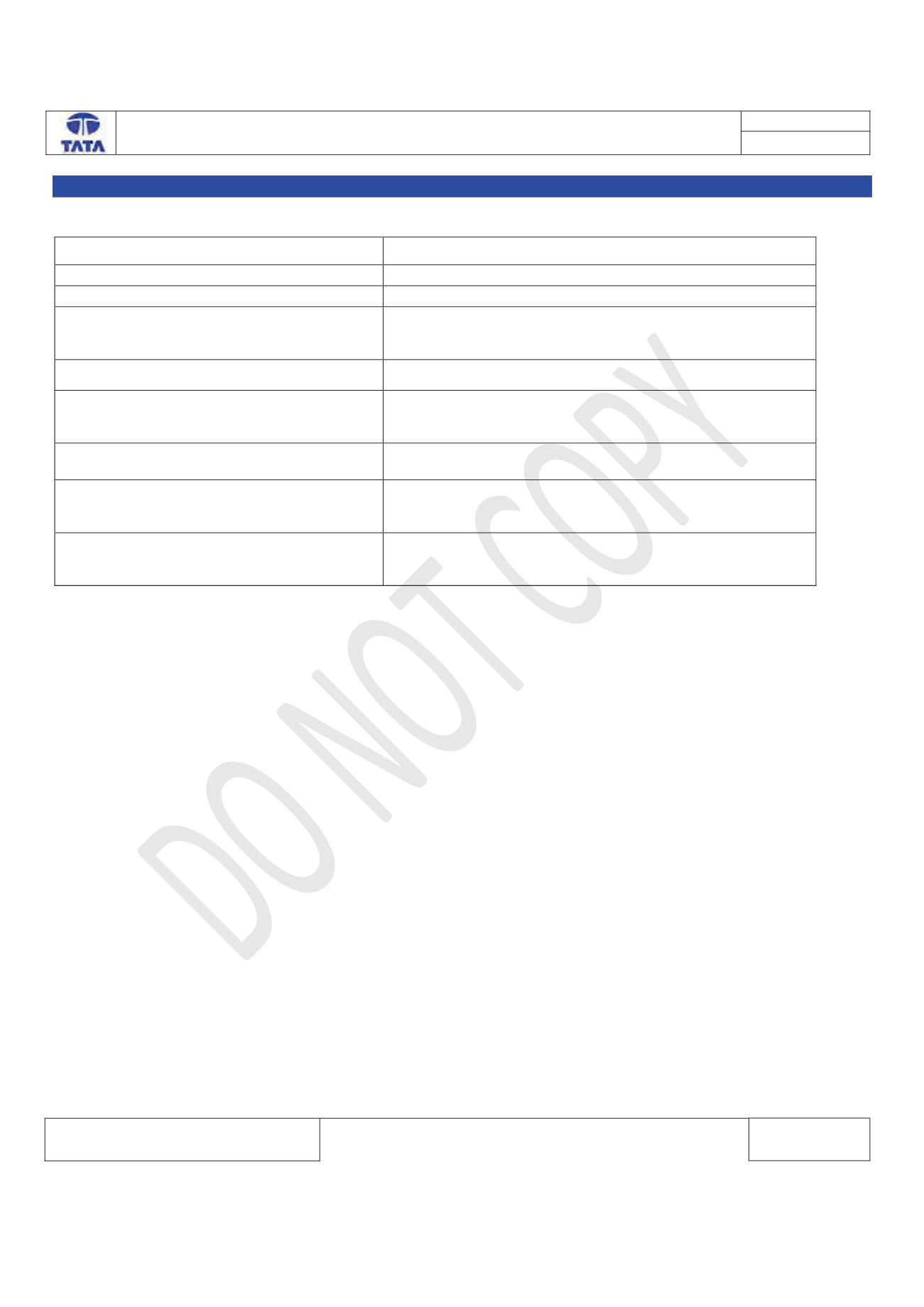
P1101: AMF sensor electrical fault
Overview:
DTC Description as per ISO standard
AMF sensor electrical fault
ECU Pin Number
55
Customer Symptom
Probable loss of power and black smoke
Fault Effects (On Vehicle)
Disables EGR by setting desired rate to 0. This will affect
EGRH rate, EGRL rate, Throttle, Intake manifold
pressure and boost pressure
Lamp Status (If Any)
CE & MIL lamp is on
Fault Detection Condition (Root cause)
This DTC gets logged due to AMF sensor electrical fault -
Look for P0101, P0102, P0103, P0104,P642, P0643, these
faults are the reason for AMF - sensor fault (P1101)
Normal Operating Condition
No Faults related to AMF sensor
Probable Trouble Area
AMF - Air Mass Flow sensor (HFM)
Related wiring Harness, connector or terminals
ECU
Healing Condition
Rectify the error
Clear through diagnostic tool
Ignition OFF & ON
Component Details:
The operating principle is based on the heating of a diaphragm (sensitive element containing two resistances
upstream and downstream of the support) in a by-pass duct through which the engine intake air flows. The hot film
membrane is maintained at constant temperature (about 120 °C higher than the incoming air temperature) by the specific
heating resistance controlled by the management electronics. The mass of air passing through the by-pass duct, giving off
heat to the membrane, thermally unbalances the two resistances to an extent directly proportional to the mass of the
incoming fluid, an imbalance that is translated through the control circuit into a resistance variation, electronically
processed and translated into a frequency value to be sent to the engine management control unit. The imbalance in the
resistance value also makes it possible to determine the direction of the column of air. As far as the air temperature
information is concerned, it is sent to the engine management control unit via a dedicated pin in the form of a duty cycle
signal (rectangular wave). The value of the duty is proportional to the value of the temperature.
Preliminary Checks:
x
Check whether the customer voice / view about the issue is matching with the fault effects mentioned above. If
yes, go ahead with next steps. If not, check for other DTC’s presence.
x
Check whether similar complaints are earlier reported. If yes, perform the preliminary checks with respect to
earlier issue closure.
x
Check for faults P 0101, P0102; P0103; P0104, P0642, P0643; Follow their rectification process for the faults,
before proceeding further.